Aeon – Anthropocene
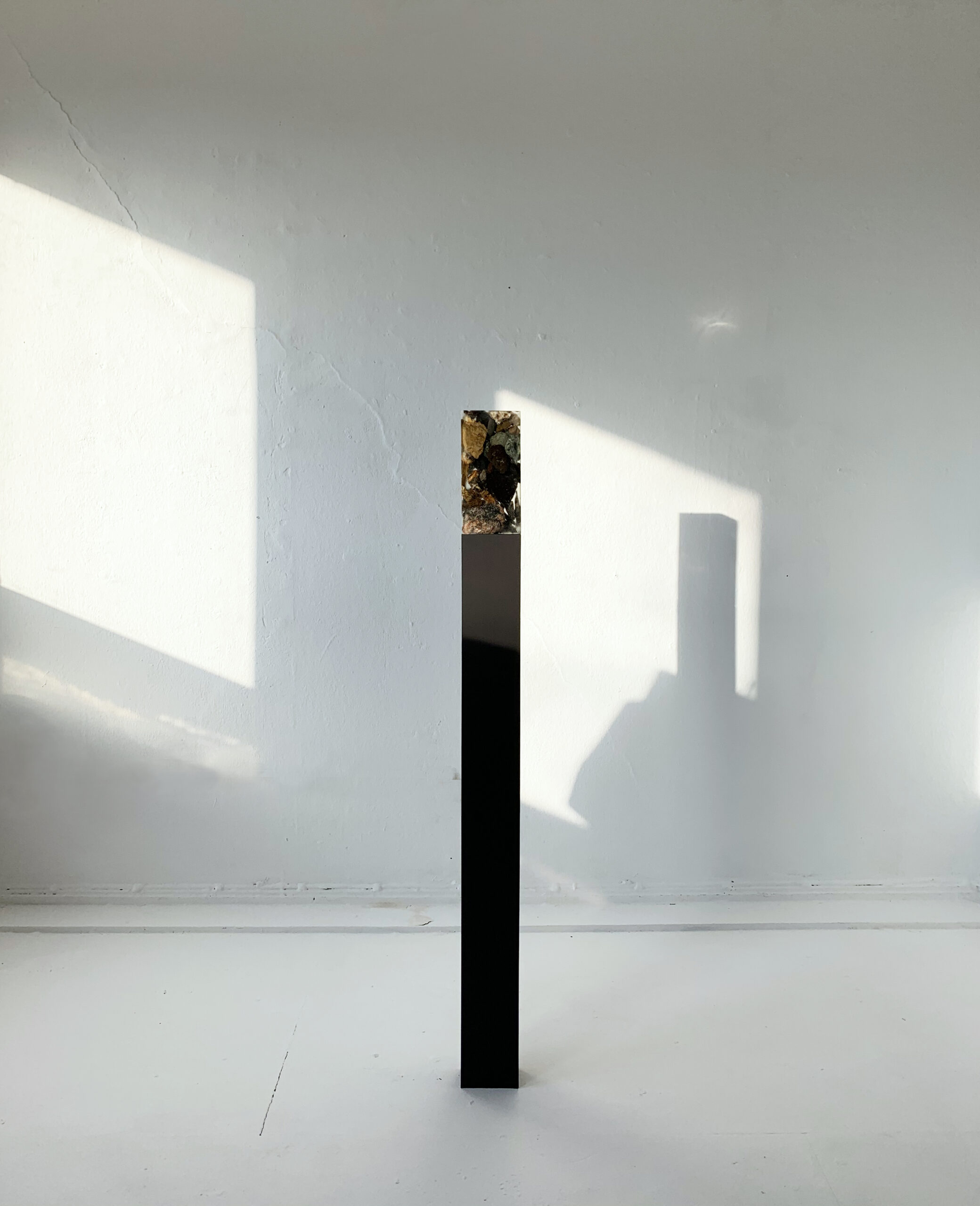
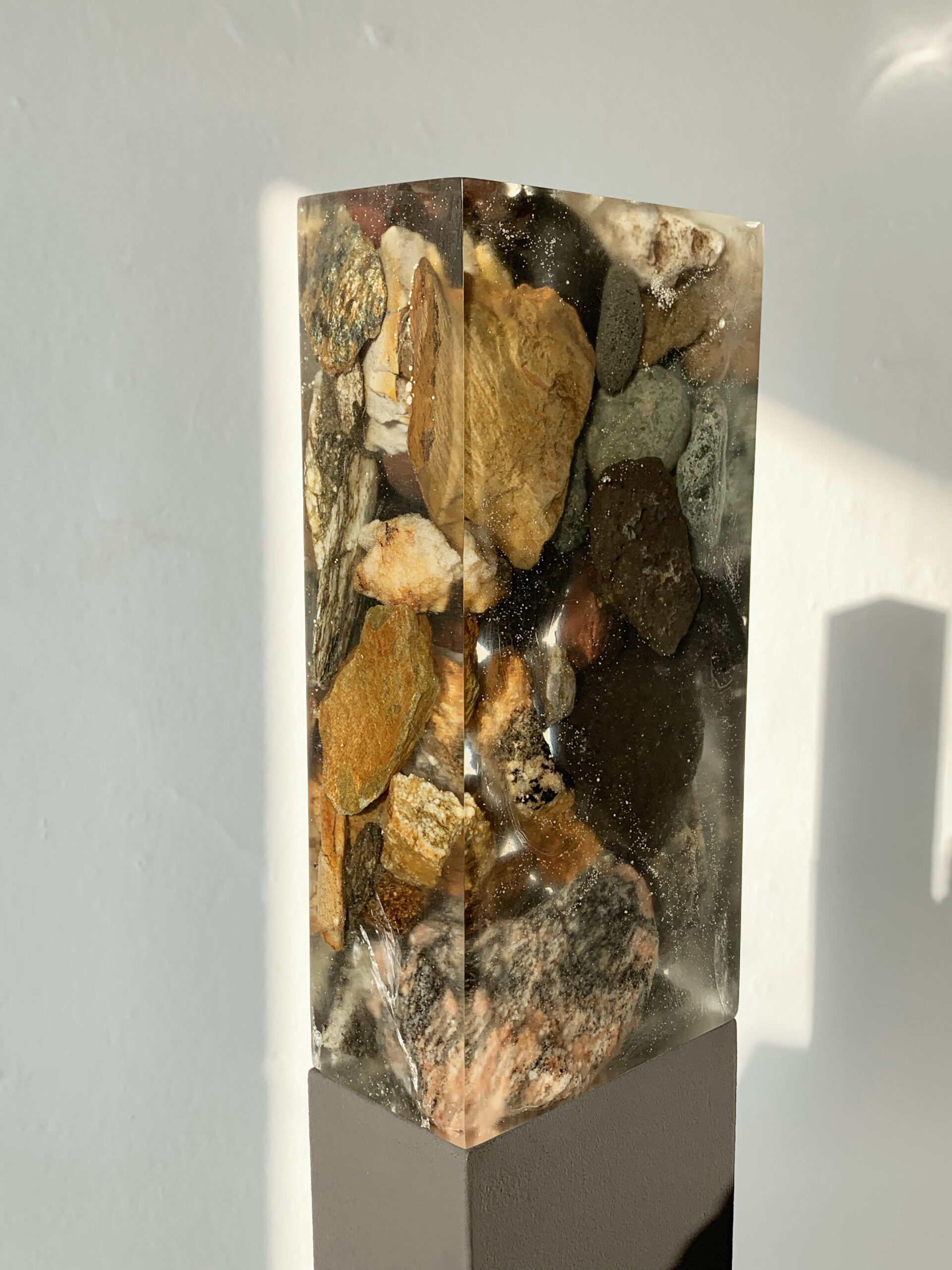
Natural Stone, Epoxy Resin, 24 x 11,5 x 6,2 cm (2021)
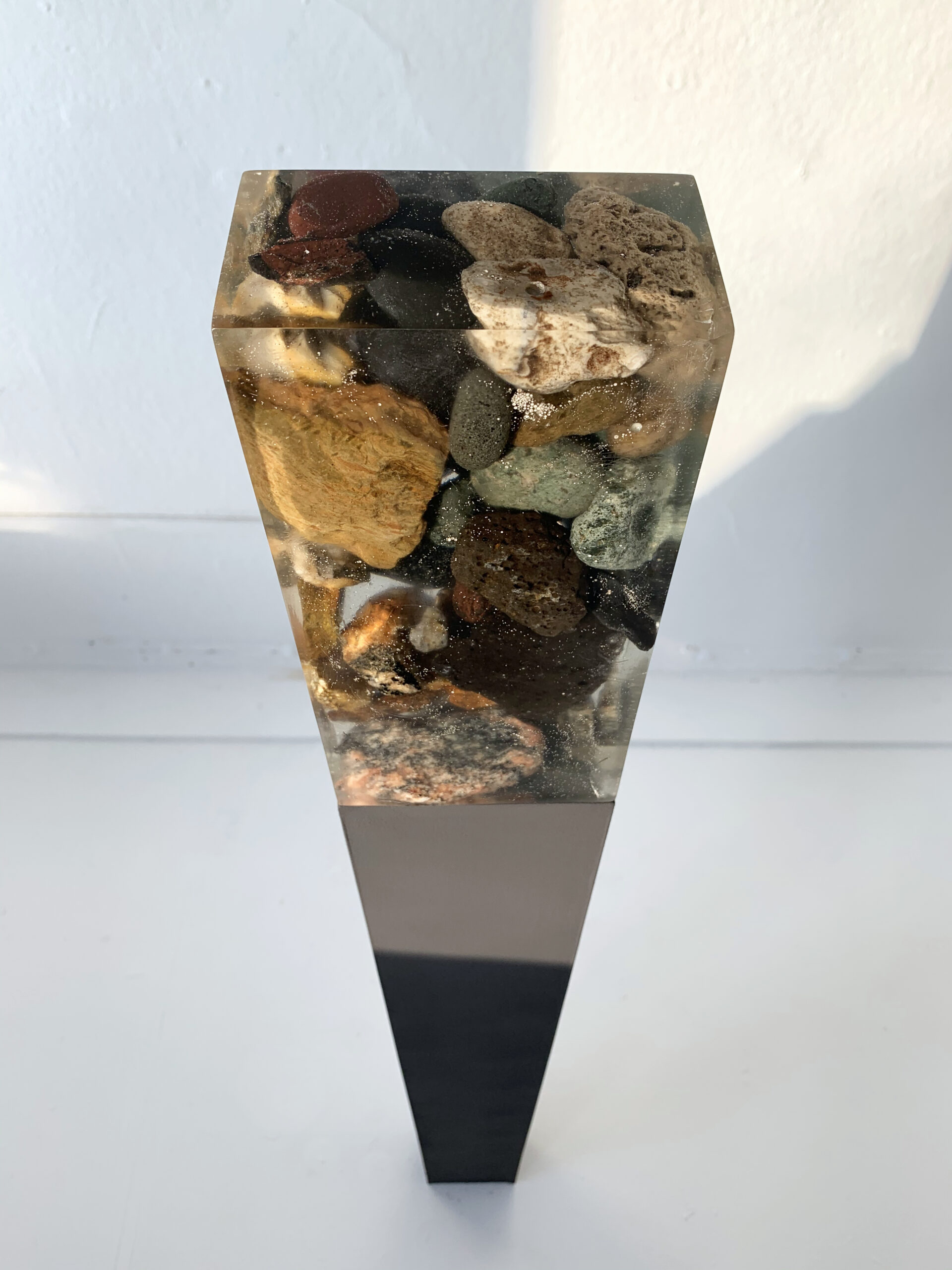
The journey begins in the Archaean, the oldest eon of the geological timescale and at the same time the earliest unit in the subdivision of Earth’s history. Inside the object lie Isua granites, rocks from this distant time that Kemper collected in Greenland. These metamorphic relics, at 3.8 billion years old, form the chronological starting point of a journey through the Earth’s formation. In that epoch, the Earth itself was still young—an evolving planet shaped by the so-called “Late Heavy Bombardment,” a period of intense meteorite and asteroid impacts.
Inside the object, progressively younger rocks follow: granites, shales, marbles, and others collected by Kemper from different mountain regions of the world. In the central section are limestones between 65 and 250 million years old—sedimentary rocks found in many regions across the globe. The 30-million-year-old marble originates from the Apuan Alps in Italy, whose quarries once produced the purest marble in the world (Carrara). The magmatic rock basalt, ejected from deep beneath Iceland into the atmosphere, forms the youngest natural layer—evidence dating from today back to 25 million years.
The journey through time ends with a synthetic stone made of epoxy resin, which unites within itself the natural rocks from different epochs. Its form and dimensions, recall a standardized brick format widely used in construction. Within the work, this also addresses the threshold from the geological epoch of the Holocene to the Anthropocene. From this point onward, it is humanity that fundamentally shapes nature—no longer nature that shapes humanity.
Within this work unfolds the transition from the geological epoch of the Holocene into the Anthropocene.
From this moment onward, it is humankind that shapes and transforms nature —
no longer nature that shapes humankind.

Naturstein, Epoxidharz, 24 x 11,5 x 6,2 cm (2021)
Die Reise beginnt im Archaikum, dem ältesten Äon der geologischen Zeitskala und zugleich der frühesten Einheit in der Unterteilung der Erdgeschichte. Im Inneren des Objekts lagern Isua-Granite, Gesteine aus dieser fernen Zeit, die von Kemper in Grönland geborgen wurden. Diese metamorphen Relikte bilden mit einem Alter von 3,8 Milliarden Jahren den chronologischen Ausgangspunkt einer Reise durch die Entstehung der Erde. In jener Epoche war die Erde selbst noch jung – ein sich wandelnder Planet, geformt durch das sogenannte „Late Heavy Bombardment“, eine Periode intensiver Meteoriten- und Asteroideneinschläge.
Im Inneren des Objekts folgen immer jüngere Gesteine: Granite, Schiefer, Marmor und andere, von Kemper gesammelt aus verschiedenen Gebirgen der Welt. Im mittleren Bereich befinden sich 65 bis 250 Millionen Jahre alte Kalksteine – sedimentäre Gesteine, wie sie in zahlreichen Regionen der Welt vorkommen. Der 30 Millionen Jahre alte Marmor stammt aus den Apuanischen Alpen, in Italien, aus dessen Minen seiner Zeit der reinste Marmor der Welt abgebaut wurde (Carrara). Das magmatische Gestein Basalt, von der Tiefe unter Island in die Atmosphäre geschleudert, bildet die jüngste natürliche Schicht – ein Zeugnis mit einem Alter von heute bis 25 Millionen Jahren.
Die Zeitreise endet mit einem synthetischen Stein aus Epoxidharz, der die Naturgesteine aus den unterschiedlichen Epochen in sich vereint. Seine Form und Maße erinnern an ein genormtes Ziegelformat, das im Hausbau weit verbreitet ist. Innerhalb der Arbeit wird dadurch unter anderem die Schwelle vom geologischen Zeitalter des Holozäns hin zum Anthropozän thematisiert. Von nun an ist es der Mensch, der die Natur maßgeblich beeinflusst – und nicht mehr die Natur den Menschen.